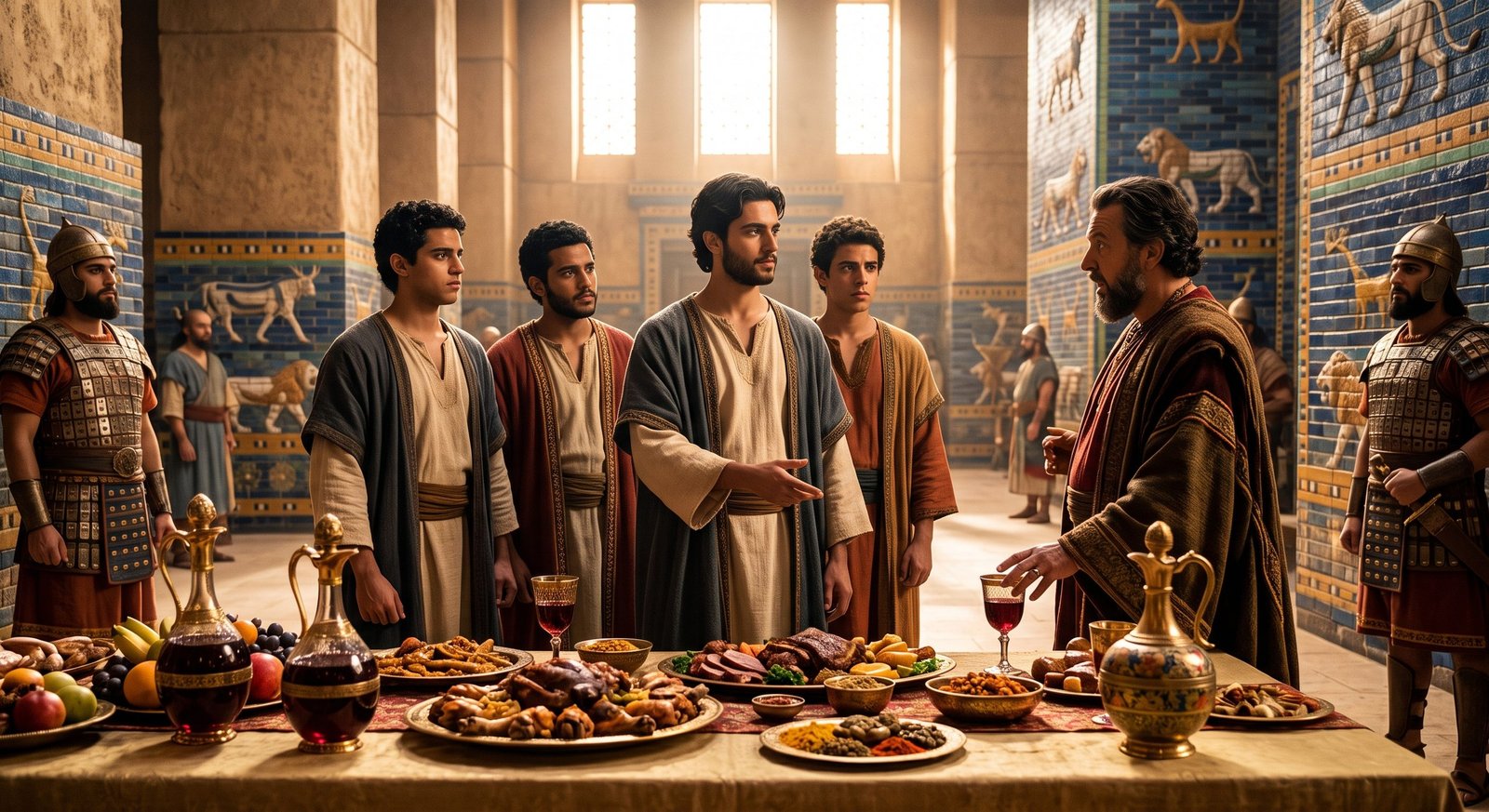
Today, I want to share a reflection based on the book of Daniel 1:1–21. Daniel’s story teaches us how to conduct ourselves in the midst of adverse conditions during the Babylonian captivity.
It was during the reign of Jehoiakim, king of Judah, that the city of Jerusalem was besieged by Nebuchadnezzar’s troops and completely devastated. The result of this invasion was the exile of the people of Israel to Babylon—a captivity that lasted 70 years in a foreign land, where Daniel himself was also taken. From this backdrop, we dive into the story of four young men who serve as an example of how to make the right choices in the face of difficult circumstances.
Being taken to an unfamiliar land, far from your home and your customs, is profoundly challenging. The king ordered Ashpenaz, chief of the eunuchs, to bring some of the young men of Israel who were of good appearance to be educated in the king’s court for three years, and so it happened. Daniel, Hananiah, Mishael, and Azariah, who were from the tribe of Judah, were chosen.
To enforce this new culture, the chief of the eunuchs gave them new names: Daniel became Belteshazzar; Hananiah, Shadrach; Mishael, Meshach; and Azariah, Abednego. The King of Babylon’s intention was to completely assimilate the people of Israel into Babylonian culture, causing God’s people to forget who they were. After all, the most effective way to dismantle a culture is to strip away its identity.
Through this narrative, Daniel shows us how to navigate the world today, because Babylon is not very different from our modern context. We are constantly confronted by corrupting influences, and amidst it all, we must make wise decisions so we do not defile ourselves with the evils of this world.
Consider these three practical points:
Knowing the Right Time to Act
These young men were forcibly taken from their homeland, brought to an unfamiliar place, pressured to adopt an entirely foreign lifestyle, and even stripped of their names—yet up to that point, they did not resist. When subjugated by an empire, two standard paths usually emerge: violently resist with an iron fist until the end, or completely surrender and assimilate into the culture.
Daniel and his friends forged a third way: they chose to act at the exact moment their core integrity was directly compromised. Being displaced from their homeland was a massive blow—especially for an Israelite, for whom the land represented God’s promise. Yet, they did not rebel during their deportation.
They were enrolled in a pagan educational system with foreign customs and values, but they did not protest there either. Even their names were changed—an intense violation of identity, given that ancient names carried spiritual meaning and declared allegiance. Still, they kept silent. But when Daniel realized something would cross the line and defile them from the inside out, he drew the line: the royal food and wine were an absolute no.
This demonstrates God-given wisdom in knowing when to act. Others can displace us, strip away our comforts, or even paste labels on us, but we still choose what we allow into our hearts and souls. They refused to defile themselves with what would destroy them. That is spiritual discernment—the wisdom to choose your battles and confront what truly matters.
Practical Application for Young People: The world will aggressively attempt to impose labels, distractions, and compromises on you. Choose your battles wisely, whether at university or among your peers. Do not lose your peace over trivial matters, but hold fast to an uncompromising “no” against anything that corrupts your soul and pulls you away from holiness.
Consistency in Your Convictions
Israel spent 70 years in Babylonian captivity, and this tactical wisdom remained with Daniel and his friends throughout their entire lives. Babylon mirrors our present world and its spiritual pitfalls, while Daniel and his companions represent what believers are called to be.
The world will not stop launching attacks against God’s people; therefore, consistency in our convictions is essential. We must deliberately choose the right path and the right mindset every single day, knowing this spiritual tension endures throughout our earthly lives. Daniel’s journey extends far past chapter 1, facing relentless tests in exile, yet he remained steadfast.
He never wavered in his conviction that the best way to live is to honor God’s will above all else. We must cultivate that same daily discipline to prioritize God’s voice over the demands of culture.
Practical Application for Young People: Consistency means living a faith that isn’t defined by emotional highs, retreat weekends, or Sunday-only devotion. The conviction you display at church must be the exact same integrity you demonstrate when facing temptations at work or school on Monday. True holiness is built on an uninterrupted routine of daily surrender.
Changing Locations Without Changing Your God
When forced into exile, human nature defaults to rebellion or complete assimilation. Daniel and his friends chose a third way: discerning what God wanted them to accomplish in that specific place and season.
Though their environment, language, and everyday routines changed completely, their faith in the living God never budged. Circumstances and scenery shift, but our reliance on the Lord must remain constant every single day.
Practical Application for Young Christians: Many of you will relocate for college, pursue new career paths, or step into entirely new environments. The scenery around you will change drastically, and social pressures will adapt to your new surroundings. Keep your heart anchored in the Lord. Wherever life takes you, let your environment bear witness to Christ in you, without ever letting that environment erode your faith. Bloom and shine wherever God plants you!
See more:
Leave a Reply