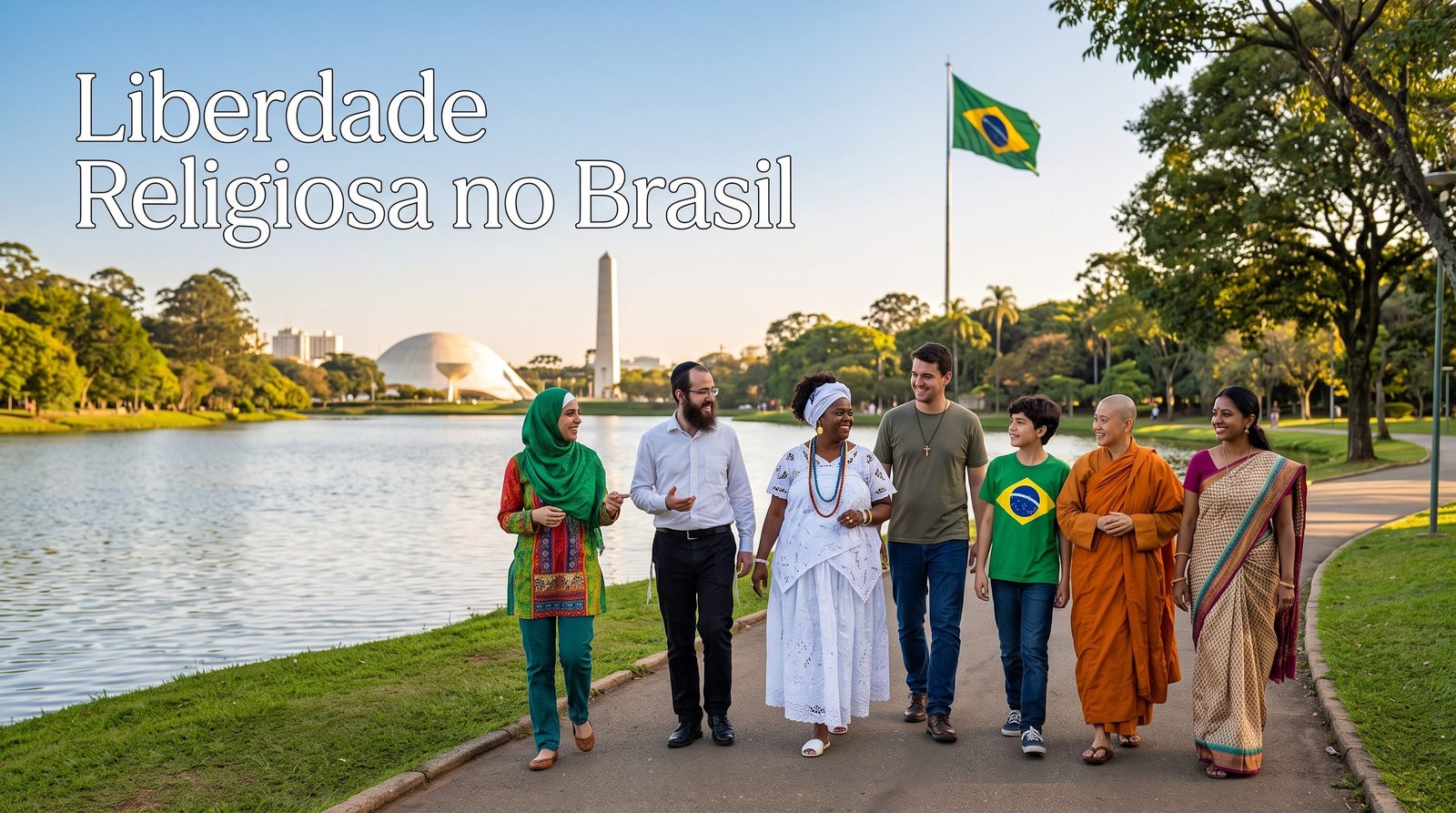
Religious freedom in Brazil is a fundamental right guaranteed to all people, regardless of their religion, belief, or lack of faith. This means that each individual can believe, not believe, change religions, participate in worship, and express their convictions, provided they respect the rights of others.
Despite constitutional protection, there are still many myths about religious freedom, the secular state, freedom of expression, and hate speech. After all, must a secular state exclude religion from public life? Is it allowed to criticize other beliefs? Can churches engage in politics? Is proselytism prohibited?
Based on a live conversation with Dr. João Victor Gonçalves, a lawyer and expert in Religious Law, this article explains the main rights related to religious freedom in Brazil, presents practical examples, and clarifies the boundaries established by Brazilian legislation.
What is Religious Freedom?
Religious freedom can be understood as the right of every person to form, maintain, and manifest their religious convictions. It is directly related to three freedoms:
- Freedom of thought: protects the free development of ideas and convictions;
- Freedom of belief: protects a person’s relationship with what they consider sacred or an object of worship;
- Freedom of conscience: results from the formation of personal convictions and guides choices and behaviors.
As presented by Dr. João Victor Gonçalves, freedom of belief includes the right to:
- Have a religion;
- Not have a religion;
- Keep the chosen religion;
- Change religions;
- Manifest or not manifest one’s convictions.
Religious freedom, in turn, is the practical dimension of freedom of belief. It protects worship, religious teaching, preaching, proselytism, the organization of communities, and other forms of manifesting faith.
The Secular State in Brazil: What Does It Mean?
Brazil is recognized as a collaborative secular state. In practice, this means the State has no official religion, must not impose a belief on the population, and cannot favor or persecute a specific religion. The secular state is not necessarily an anti-religious state. This is an important distinction. There are models of relations between State and religion that range from theocracy and the confessional state to laicism and secularism. Brazil adopts a model of separation with the possibility of collaboration on matters of public interest.
The 1988 Federal Constitution establishes, in Article 19, item I, that the government is forbidden to:
“Establish religious cults or churches, subsidize them, hinder their functioning, or maintain with them or their representatives relations of dependence or alliance, with the exception, in the form of the law, of collaboration of public interest.”
At the same time, the Constitution protects religious freedom in Article 5, item VI:
“Freedom of conscience and belief is inviolable, ensuring the free exercise of religious cults and guaranteeing, in the form of the law, the protection of places of worship and their liturgies.”
Therefore, a secular state does not mean removing religion from the public space, but ensuring that no belief is imposed by the State and that all people are treated equally.
Main Myths About Religious Freedom in Brazil
Myth 1: A secular state means a state without religion or against religion Truth: The secular state must not have an official religion, but it also cannot combat religious faith. Its duty is to ensure that religious people, atheists, agnostics, and members of different traditions have their rights respected. A government can, for example, protect the historical heritage of a church, mosque, synagogue, terreiro, or Buddhist temple due to its cultural value. This does not mean adopting that religion, but protecting an asset of public interest.
Myth 2: Religious freedom only protects worship inside the temple Truth: Religious freedom also protects manifestations outside places of worship. The right can encompass preaching in public spaces, teaching a doctrine, publishing religious books, participating in social activities, and the institutional organization of a community. The Supreme Federal Court (STF) recognized, in the judgment of RHC 134.682, that proselytism—that is, the attempt to persuade or win new followers—can integrate the essential core of freedom of religious expression.
This does not authorize threats, persecution, or coercion. The manifestation must occur legitimately and without violence or discrimination.
Myth 3: It is forbidden to criticize or compare religions Truth: Religious criticism, comparing doctrines, and defending a belief can be protected by freedom of expression and religious freedom. A person can state that they consider their religion to be true or that they disagree with another tradition. The limit arises when the speech ceases to be a manifestation of conviction and begins to advocate the human inferiority of a specific group, violence, exclusion, or the elimination of people. In other words, criticizing a doctrine is different from attacking the dignity of its followers.
Myth 4: Any offensive speech is hate speech Truth: Not every unpleasant, harsh, or offensive speech constitutes hate speech. According to Dr. João Victor Gonçalves, hate speech involves two central elements:
- Discrimination: the assertion that a certain group or person is inferior, unworthy, or does not deserve to exercise their rights;
- Externality: a public manifestation or action that produces concrete effects of hostility, domination, suppression, or violence.
Thus, hate speech is not simply “speaking out of anger.” It occurs when the manifestation seeks to attack the fundamental rights and dignity of individuals or groups.
Myth 5: Religious freedom allows defending violence against other groups Truth: No fundamental freedom authorizes violence, persecution, or discrimination. Religious speech may be protected, but not when it encourages aggression or states that a certain person should be excluded, dominated, or eliminated due to their religion, sexual orientation, gender identity, or other personal characteristics. Religious freedom must be exercised in conjunction with other fundamental rights, such as equality, honor, image, dignity, and physical integrity.
Myth 6: Religious people cannot participate in politics Truth: The secular state does not prohibit religious people from running for public office or participating in political debate. Citizenship does not depend on whether a person is religious or not. What cannot happen is the use of public power to impose a religion, discriminate against other beliefs, or turn a private conviction into a state obligation incompatible with the Constitution.
What Rights are Guaranteed by Brazilian Legislation?
Right to have, not have, or change religion Freedom of belief protects both those who follow a religious tradition and those who have no religion. It also guarantees the right to change beliefs without facing punishment, discrimination, or coercion. Practical example: A person cannot be prevented from attending a school, working, or accessing a public service because they changed their religion or declared they follow none.
Right to the free exercise of worship The Constitution guarantees the performance of individual or collective, public or private worship, provided general applicable rules and the rights of third parties are respected. Practical example: Public authorities cannot interrupt a religious service simply because they disagree with the practiced doctrine. Any limitations must have a legal basis, such as safety rules, operating hours, noise limits, or the protection of physical integrity.
Protection of places of worship and liturgies Temples and religious spaces have legal protection. The destruction, invasion, vandalism, or disruption of religious activities can lead to civil and criminal consequences. This protection extends to different traditions, including Christian churches, Umbanda and Candomblé terreiros, Spiritist centers, synagogues, mosques, Indigenous temples, and other faith communities.
Right to teach and spread the faith Religious freedom encompasses the teaching of beliefs, publication of books, hosting of lectures, preaching, and the public defense of a doctrine. The Supreme Federal Court has already highlighted that, in religions with universal claims, proselytizing speech can be an essential part of religious expression. The central point is that the dissemination must not turn into threats, violence, or discrimination.
Right to organize a religious community People can form associations, churches, centers, terreiros, institutes, and other religious organizations. These institutions have the autonomy to define their internal structure, rituals, membership rules, and doctrinal orientation, in compliance with the law. This autonomy is especially relevant in matters such as choosing leaders, organizing ceremonies, setting requirements for ministers, and managing internal activities.
Right to equality and protection against religious intolerance No one can be disadvantaged because of their religion. Religious intolerance can occur in workplaces, schools, public spaces, social networks, and neighborhood relations. Examples of religious intolerance:
- Preventing someone from wearing religious clothing;
- Mocking sacred symbols;
- Destroying or desecrating objects of worship;
- Preventing the holding of a ceremony without legal justification;
- Denying employment, care, or service due to belief;
- Associating a religion with the inferiority or criminality of its followers.
In situations of discrimination, it is important to gather evidence, such as messages, videos, witnesses, and formal records, as well as seek legal guidance and report the incident to the competent authorities.
Religious Freedom and Hate Speech: Where is the Limit?
Freedom of religious expression is broad, but it is not unlimited. The legal limit is not simply the fact that a statement displeases someone. The issue is to verify whether there was objective discrimination, an attack on dignity, incitement to violence, or the defense of the suppression of rights. The religious speech remains protected when it presents a doctrine, makes a theological critique, or seeks to persuade someone. However, it can lead to liability when it asserts that a certain group is inferior as human beings and, therefore, should suffer violence, be excluded, or lose their rights.
The STF, in RHC 134.682, also recognized that religious freedom and freedom of expression must be exercised in harmony with other fundamental rights. Therefore, protecting religious freedom does not mean tolerating religious racism or the persecution of minorities.
How to Act When Facing a Violation of Religious Freedom?
When experiencing or witnessing religious intolerance, some measures can help:
- Record the date, location, and description of the facts;
- Keep messages, videos, audios, and publications;
- Identify witnesses;
- Contact the administration of the school, company, or institution involved;
- File a police report when there is a crime or threat;
- Seek guidance from a lawyer or a rights defense agency;
- Avoid responding with violence or threats, preserving the evidence.
The analysis of each case depends on the context, the words used, the reach of the manifestation, and the effects produced.
Conclusion
Religious freedom in Brazil protects both the intimate dimension of belief and its public manifestation. Every person has the right to have a religion, not have a religion, change their convictions, participate in worship, teach their faith, proselytize, and organize a religious community. The secular state is not a state against religion. Its role is to ensure neutrality, equality, and protection for different beliefs and also for those who have no faith. At the same time, religious freedom cannot be used to justify violence, discrimination, or hate speech.
As Dr. João Victor Gonçalves points out, defending freedom requires knowledge, responsibility, and respect for fundamental rights. Being informed about the legislation is an essential step toward combating religious intolerance and strengthening a plural, democratic, and inclusive society.
See more:
- A New Creature: Behold, All Things Have Become New
- Young Christian creates the “Fala Comigo” app for non-verbal autistic children
- John’s Vision of Revelation
Leave a Reply