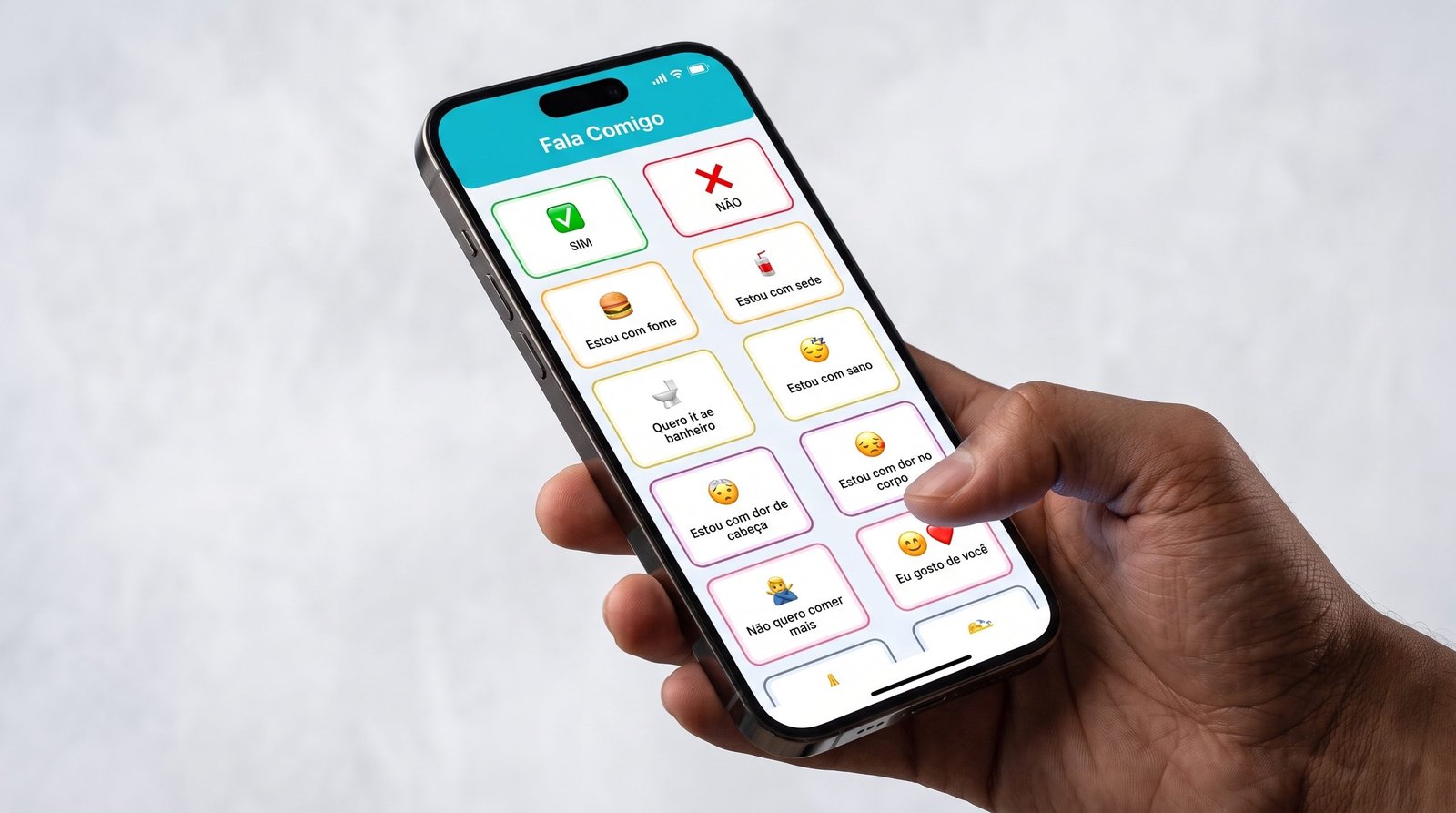
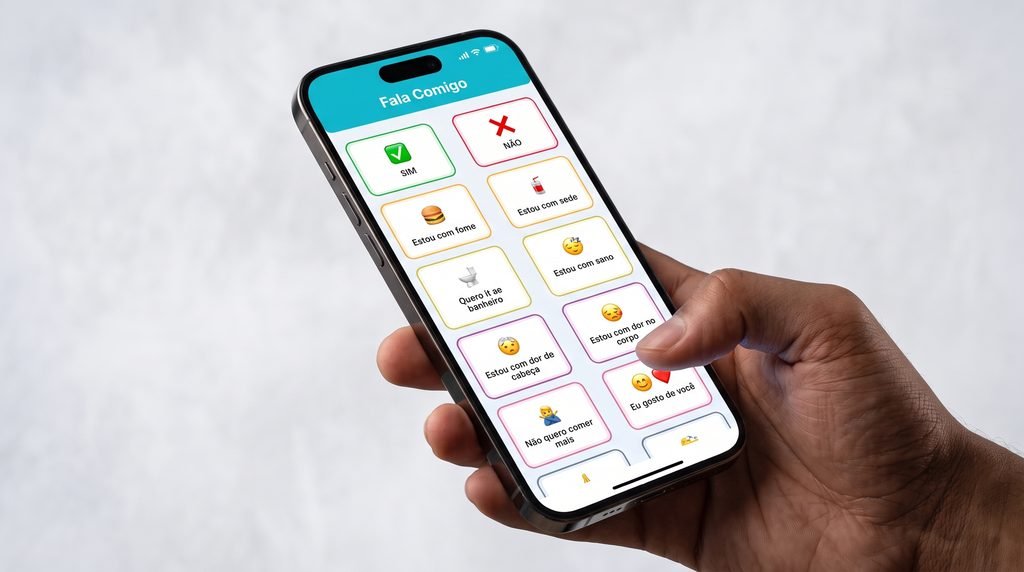
For student Henrique Ernesto Rodrigues Costa, serving God also involves technology. A young Baptist and member of the First Baptist Church in Parauapebas, he is part of the team that developed the Fala Comigo (Talk to Me) App, which aims to support the communication of non-verbal autistic children. The initiative brings Christianity, autism, and inclusion closer to an everyday need: allowing a child to express hunger, thirst, discomfort, or a choice. More than just developing software, this project is a true opportunity to love one’s neighbor.
In an interview with the Teólogo Pedro Barros blog, he shared the origin of the project, the role of prayer in this journey, and his expectations for schools, families, and churches. His story reveals how professional training can connect with Christian service. The link to the interview will be at the end of the article.
Faith and technology serving others
The project is linked to the Bachelor’s degree in Software Engineering at the Pará State University (UEPA), Curionópolis campus. In this academic environment, Henrique participated in an experience that connected technical knowledge, social responsibility, and personal convictions. The motivation stemmed from a concrete situation. According to him, a team member, who is a school principal in Curionópolis, reported the communication difficulties of two non-verbal autistic children assisted at the institution. The problem wasn’t simply supervising the children. It was understanding what they wanted to communicate when speech was unavailable.
“Even with the tutor right there next to the child, next to the neurodivergent individual, the tutor has to guess what the child wants to say.”
This account mobilized the team to research alternatives. For Henrique, the answer needed to be simple, accessible, and useful in common situations, such as asking for water or indicating a need.
Prayer accompanied the development
In the interview, Henrique does not present his faith as a separate detail from his academic life. He reports that prayer was present throughout the project’s execution.
“We were always in prayer about this project so that it would be completed successfully, so we could move it forward.”
His understanding of calling also goes beyond activities performed within the Church. He associates professional practice with the Christian commitment to the well-being of others:
“If I am helping another person, regardless of the field, I am serving the Lord’s work.”
This perspective connects with the word of God in 1 Peter 4:10, which guides Christians to use the gifts they have received to serve one another. In the journey narrated by Henrique, software engineering appears as a concrete way to live out this principle.
A collective creation: meet the authors and advisors
Although Henrique’s experience is the center of this story, the app for non-verbal autistic children is the result of collective work. The authors include:
- Dédalo Dorneles Ferraz de Oliveira;
- Henrique Ernesto Rodrigues Costa;
- Igor Herculano Silva.
The project was advised by Prof. Esp. Wilker José Caminha dos Santos, with co-advising by Dr. Milta Mariane da Mata Martins.
The work was titled “Fala Comigo: mobile application to support the inclusion of non-verbal students with Autism Spectrum Disorder.” The provided presentation identifies UEPA as the institution responsible for the project’s progress. The materials attribute the research, comparative analysis, and solution development to the team, but do not detail the individual division of tasks. This distribution is information contained within the students’ own dynamics. Recognizing all participants preserves the collaborative nature of the initiative. Henrique’s leading role as a young Christian does not diminish the contribution of the other authors nor the guidance of the advisors.
How does the Fala Comigo App work?
The Fala Comigo App was created as an Augmentative and Alternative Communication (AAC) tool. This approach gathers resources that complement or offer alternatives to speech for people with complex communication needs. In practice, the interface organizes buttons into a visual grid. Each button associates a symbol with a message, and the device plays the phrase aloud when it is activated.
Among the examples presented are:
- “Yes” and “no”;
- “I am hungry” and “I am thirsty”;
- Expressions of emotions and discomforts;
- Social interactions, such as “thank you” and “sorry”.
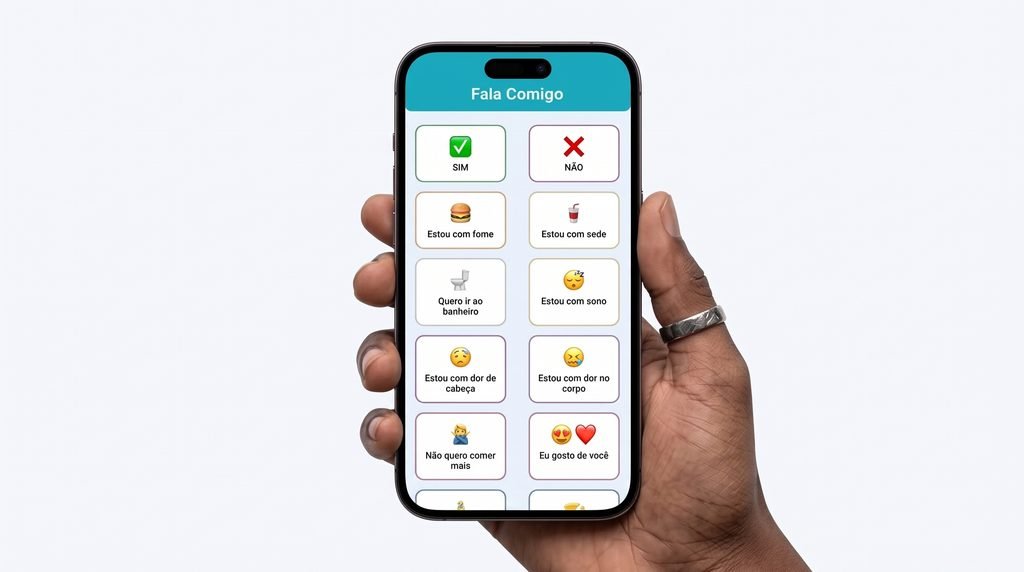
The provided image also illustrates this proposal, displaying everyday needs and expressions of affection. The goal is to expand the possibilities of expression without requiring reading as a condition of use.
Emojis, speech synthesis, and a simple interface
Henrique explains that the team chose emojis to represent messages visually. The intention was to use familiar symbols and reduce the reliance on literacy. However, the understanding of these symbols should not be considered universal. Each child may need gradual introduction, mediation, and adaptations according to their skills and preferences.
According to the academic materials, the solution uses React Native and Expo, with a cross-platform proposal for Android and iOS. Speech synthesis is performed by the expo-speech library, which transforms the text associated with the button into speech. The presentation also details JavaScript and Node.js in the technological stack. Furthermore, it logs a feature to repeat the last phrase and anticipates future expansions, such as new messages, a PIN, and control over the interval between activations.
These latter possibilities are presented as planned evolutions, not as fully available features.
From school necessity to responsible development
The creation process involved bibliographic and documentary research, requirements gathering, comparison of tools, and software development. Among the references are studies on autism, assistive technologies, and school inclusion. The team also consulted the BNCC (National Common Curricular Base) and the Brazilian Law of Inclusion, linking communicational accessibility to the right to participate and learn with equity.
In the interview, Henrique reports that the initial search did not find a solution that met what they were looking for. The slides themselves, however, acknowledge existing tools, such as PictoTEA and ABC Autismo, with different proposals and characteristics. Thus, the intended differentiator of Fala Comigo is not to pioneer digital alternative communication. It is to offer a combination of visual simplicity, everyday communication, and speech synthesis in Portuguese.
What has already been evaluated and what still needs to be tested
An important detail from the interview is the transparency regarding the project’s stage: the application had not yet been tested with children in a school environment. Henrique describes an evaluation based on literature and scenarios built from the consulted references. Although he uses the expression “empirically,” his account does not describe field research with students.
The presentation confirms that the next step is submission to the Research Ethics Committee, followed by empirical validation and impact evaluation in a public school. Therefore, the benefits for the children represent application potential, rather than clinical or educational results already proven within this app. This information is the responsibility of the educational institution, which is the official owner of the app at the moment.
Autism and inclusion in the church: a matter of dignity
When imagining new contexts of use, Henrique mentions families and Christian communities:
“Why not inside churches, right? Because it’s a means, a type of inclusion. Everyone has the right to communicate.”
His reflection finds its foundation in human dignity. In Genesis 1:27, creation in the image of God offers a theological basis for recognizing the value of each person, regardless of their ability to speak. Therefore, inclusion in the church should not be understood merely as allowing physical presence. It involves removing barriers to participation, respecting different forms of communication, and acknowledging choices. The absence of speech does not mean the absence of communication.
Possibilities for Sunday school and children’s ministry
Henrique imagines the app supporting Sunday school situations: indicating thirst, answering a question, or showing a desire to hear an explanation again. With individual assessment and proper guidance, AAC resources can integrate welcoming practices. However, the technology must be accompanied by concrete attitudes:
- Listening to the child and their guardians;
- Respecting refusals and signs of discomfort;
- Preparing teachers and volunteers;
- Considering sensory needs;
- Seeking collaboration from qualified professionals.
Spiritual participation also requires care. A child’s dignity and their belonging to the community do not depend on a verbal response, nor should they be reduced to the press of a button. In this sense, Christian technology here describes a motivation for service, not a tool restricted to Christians. The commitment to others must reach people of any belief.
When talents turn into care
Henrique Ernesto’s story shows a young Baptist Christian seeking to transform knowledge into care. Alongside Dédalo, Igor, and their advisors, he participated in the creation of a tool that seeks to reduce communication barriers. The Fala Comigo App still needs to advance in user testing. Even so, its proposal already raises a relevant question: how can our talents contribute to a more inclusive society and church?
Henrique summarizes his encouragement directly:
“I think it’s important for us to take the first step. You know? With God, but taking the first step.”
In light of the commandment to love one’s neighbor in Mark 12:31, this first step can happen in programming, education, healthcare, or community welcoming. Serving also means creating conditions so that others are understood, respected, and heard. This encouragement applies to you as well. Everyone, with their gifts and talents, can use them to do the share of good that this world needs.
Sources used: interview with Henrique Ernesto granted to the Teólogo Pedro Barros blog; academic presentation of the Fala Comigo project, provided by student Henrique Ernesto; image of the interface provided within the project’s presentation.
Interview Link: Click here (Only in portuguese).
See more:
Leave a Reply